
What Is Data Center Decommissioning?
A data center shutdown rarely fails because the servers are hard to remove. The real risk sits in the surrounding infrastructure – energized electrical gear, battery strings, cooling systems, fire suppression components, and miles of interdependent equipment that cannot simply be unplugged and hauled away. That is why the question of what is data center decommissioning matters well beyond IT. It is an operational, safety, environmental, and asset recovery process that needs disciplined execution.
What is data center decommissioning?
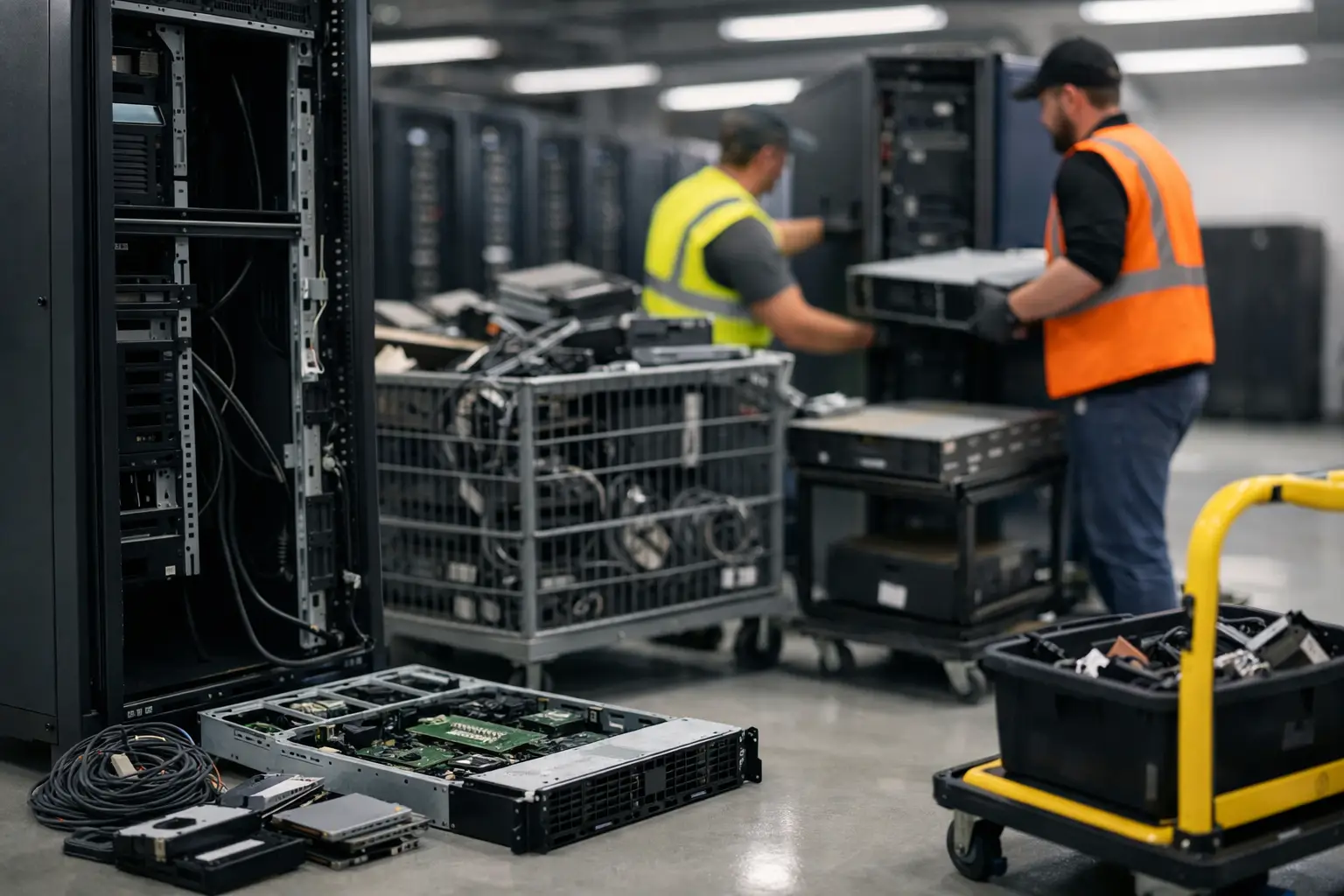
Data center decommissioning is the planned retirement, removal, and disposition of data center infrastructure after a closure, relocation, upgrade, consolidation, or equipment replacement project. It includes far more than taking out servers and racks. In most facilities, the larger scope involves disconnecting and removing UPS systems, batteries, generators, switchgear, PDUs, cooling units, chillers, CRAH or CRAC equipment, cabling, busway, raised flooring, and other support systems tied to the site.
Done properly, decommissioning protects people, preserves uptime where systems remain active, documents chain of custody, and routes assets toward resale, refurbishment, recycling, or regulated disposal. Done poorly, it creates avoidable downtime, safety exposure, environmental liability, and lost residual value.
For facility owners and infrastructure managers, the practical definition is simple. Data center decommissioning is the controlled process of taking a site or system out of service while managing risk, compliance, and equipment value.
Why data center decommissioning is more complex than equipment removal
A mission-critical facility is built around dependencies. Power equipment supports cooling. Cooling supports IT load. Battery systems support UPS continuity. Fire suppression and monitoring systems are tied to occupied space and life safety requirements. Even in a partial shutdown, one wrong disconnect can affect adjacent operations.
That complexity is why decommissioning should be treated as a project with engineering, scheduling, lockout/tagout, rigging, logistics, and disposition planning built in from the start. The work often happens in live environments, shared buildings, leased facilities, colocation spaces, or campuses where some infrastructure is being retired while other systems remain in service.
There is also a financial dimension. Retired equipment is not always scrap. Generators, switchgear, UPS modules, battery cabinets, cooling equipment, and raised floor systems may still hold secondary market value depending on age, condition, manufacturer, maintenance history, and removal timing. If a project is managed only as demolition, that value is often lost.
The main goals of a decommissioning project
Most owners are balancing four priorities at once. First is safety. High-voltage gear, stored battery energy, refrigerants, and heavy equipment require experienced handling. Second is continuity. If part of the site remains active, the work must be sequenced to avoid service disruption. Third is compliance. Waste streams, refrigerant recovery, battery handling, and documentation all have legal and environmental implications. Fourth is cost control, which includes labor efficiency but also value recovery from surplus assets.
These goals can compete with each other. A fast schedule may reduce facility carrying cost but can limit resale options if equipment is removed without testing, documentation, or preservation. A project that prioritizes maximum asset recovery may require more planning and selective dismantling. The right approach depends on the facility condition, shutdown timeline, and the type of equipment being retired.
What equipment is usually involved
When people think about decommissioning, they often picture server racks first. In reality, the heavier and more specialized infrastructure usually drives the project scope.
Power systems
This category often includes generators, ATS units, switchgear, transformers, UPS systems, PDUs, RPPs, bus duct, cabling, and large battery strings. These assets demand careful isolation, disconnect verification, rigging plans, and transport coordination. Batteries add another layer because chemistry, condition, and weight affect handling and recycling requirements.
Cooling systems
Cooling assets may include chillers, CRAH units, CRAC units, condensers, pumps, piping, cooling towers, and associated controls. Refrigerant recovery and environmental handling standards are central here. Removal may also involve roof work, crane access, and building coordination.
Facility support systems
Raised flooring, fire suppression equipment, fuel systems, monitoring infrastructure, cable tray, security systems, and structured cabling are commonly part of the scope. Some of these materials can be reused or recycled, while others require controlled disposal.
How the decommissioning process typically works
No two facilities are identical, but a sound process follows a clear sequence.
Assessment and scope definition
The first step is understanding what is installed, what is still active, what must remain, and what has value. This usually involves a site walk, asset inventory, review of drawings if available, and identification of special handling issues such as energized gear, refrigerants, hazardous materials, or restricted access conditions.
A good assessment also separates owned assets from leased equipment and clarifies who is responsible for final building condition. That matters in lease exits and colocation environments, where handback requirements can be stricter than the removal scope originally assumed.
Planning and sequencing
Once the scope is defined, the project team builds a removal plan. This covers shutdown sequencing, lockout/tagout procedures, crane or rigging needs, freight coordination, labor staging, recycling paths, and documentation requirements. If the site is partially operational, the plan should clearly identify protected systems and work windows.
This stage is where experienced contractors earn their value. The safest project is not always the one with the most labor on site. It is the one with the clearest sequence, best coordination, and fewest surprises.
Shutdown, disconnect, and dismantling
After approvals are in place, equipment is powered down, isolated, verified, and physically disconnected. Dismantling follows the constraints of the building, the size of the equipment, and the final disposition route. A generator sold for reuse may be removed very differently from one being processed for scrap.
The same is true for UPS systems, switchgear, and chillers. Preserving asset value requires cleaner extraction, complete components, serial tracking, and less destructive handling.
Removal, logistics, and site clearing
Once assets are dismantled, they are staged, loaded, and transported according to destination. Some go to resale channels, some to refurbishment, and some directly to material recycling. Scrap segregation can make a meaningful difference in project economics, especially for copper, aluminum, steel, and other recoverable materials.
Site clearing may also include floor restoration, debris removal, and final broom-clean condition if required by the owner or landlord.
Documentation and final disposition
The project should end with records that show what was removed, where it went, and how regulated materials were handled. For many operators, that documentation matters as much as the physical removal. It supports internal controls, environmental reporting, and closeout with landlords, auditors, or corporate stakeholders.
Where asset recovery fits in
One of the biggest misconceptions around decommissioning is that every retired asset is a disposal cost. In many cases, there is recoverable value in late-model or well-maintained power and cooling equipment. Even when full-system resale is not practical, components and raw materials may still offset project cost.
That said, value recovery is not automatic. Condition matters. So do manufacturer demand, service history, completeness, and timing. Equipment removed after prolonged neglect or damage usually trends toward recycling value, while equipment retired during planned upgrades may be a stronger candidate for resale or refurbishment.
This is where a provider with both decommissioning capability and equipment purchasing experience has an advantage. Instead of treating removal and disposition as separate problems, the project can be structured around the best total outcome – safe execution, compliant handling, and realistic value capture.
Common risks if the project is handled poorly
The most expensive mistakes are usually not visible at the start. An undocumented disconnect can affect active systems. Incomplete battery handling can create safety and environmental exposure. Refrigerant mismanagement can trigger compliance issues. Aggressive demolition can destroy resale value in equipment that could have been remarketed.
There is also a vendor management risk. If one contractor handles electrical disconnects, another handles rigging, another handles scrap, and another handles final cleanup, accountability gets fragmented fast. For complex facilities, a coordinated service model often reduces delays and scope gaps.
When to bring in a specialist
If the project involves heavy electrical gear, battery systems, generators, cooling equipment, or a live facility environment, specialized support is usually warranted. The same is true when the owner wants to recover asset value rather than pay only for removal.
Companies such as Critical Asset Recovery are built for this overlap between dismantling, purchasing, recycling, and responsible disposition. That matters because the work is not just about taking equipment out. It is about taking it out safely, efficiently, and in a way that aligns with both operational and financial goals.
A well-run decommissioning project leaves more than empty floor space behind. It leaves a clean record, reduced risk, and a clearer path for whatever comes next at the site.