
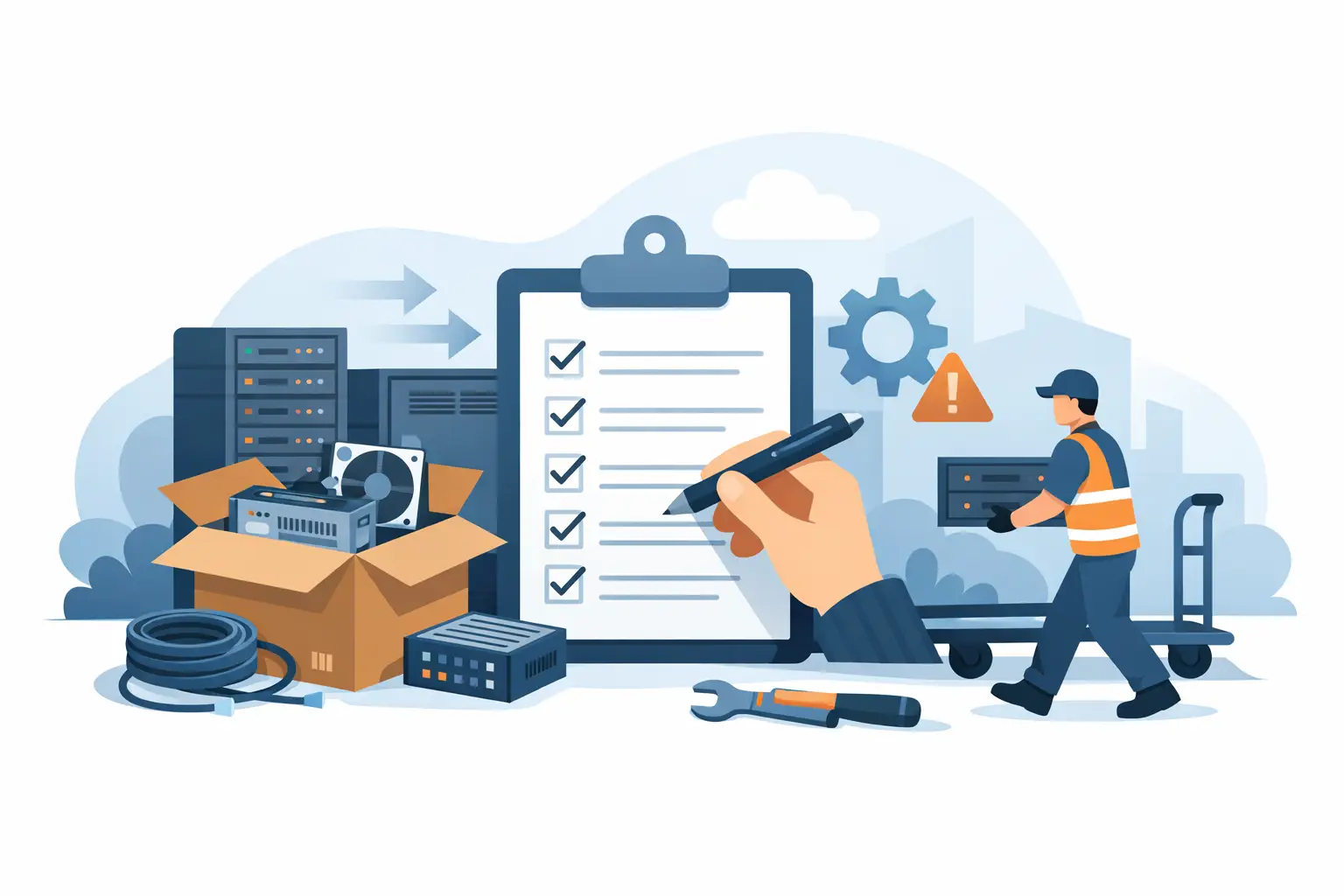
Data Center Decommissioning Checklist
A missed handoff during a shutdown can turn a controlled project into a costly disruption. That is why a data center decommissioning checklist matters. When power, cooling, batteries, IT infrastructure, and resale or recycling decisions all move at once, the work needs structure, sequencing, and accountability.
For facility leaders, the real challenge is not just removal. It is preserving continuity, protecting personnel, documenting disposition, and recovering value from assets that still have market demand. A good plan treats decommissioning as an operational project, not a scrap job.
What a data center decommissioning checklist should actually cover
Most decommissioning problems start before any equipment is touched. Scope is often loosely defined, asset records are incomplete, and stakeholders assume someone else owns compliance, salvage, or shutdown approvals. That is where avoidable delays show up.
A practical data center decommissioning checklist should cover five areas: project scope, operational risk, equipment disposition, removal logistics, and environmental compliance. If one of those areas is weak, the entire job becomes harder to control.
The level of detail depends on the site. A single room retirement inside an active facility requires careful isolation and protection of adjacent systems. A full site closure adds more moving parts, including demolition, utility coordination, broader environmental review, and final property turnover requirements.
Start with scope, ownership, and site conditions
Before shutdown sequencing is discussed, confirm exactly what is being retired and what must remain live. That sounds obvious, but mixed-use environments create confusion fast. Legacy UPS strings, abandoned cabling, shared switchgear sections, raised floor systems, and leased equipment can all blur the boundary between active and retired infrastructure.
Document the project scope in plain terms. Identify rooms, systems, support equipment, and any exclusions. Confirm who is responsible for approvals, escort requirements, electrical lockout procedures, and final signoff. If contractors, landlords, tenants, and internal operations teams are all involved, define decision authority early.
Site conditions matter just as much. Access routes, loading dock constraints, rigging limitations, ceiling heights, floor loading, battery handling requirements, and local disposal rules can change the method and cost of the work. A walkthrough should happen before pricing, not after trucks are scheduled.
Build the asset inventory before removal begins
Asset recovery depends on knowing what is there, what condition it is in, and whether it can be remarketed, refurbished, recycled, or scrapped. Too many projects treat inventory as a paperwork exercise. In reality, it drives scheduling, labor planning, environmental handling, and value recovery.
Create a field-verified equipment list that includes manufacturer, model, serial number, voltage, capacity, age, and observed condition where possible. For infrastructure assets, note whether the equipment is complete, disconnected, damaged, missing components, or still under service contract. Good records support better disposition decisions and reduce disputes later.
This is especially important for high-value equipment such as generators, UPS systems, switchgear, PDUs, battery cabinets, CRAC units, chillers, transformers, and facility support systems. Some assets have a strong secondary market. Others are best managed through material recovery. The right path depends on age, service history, working condition, code relevance, and removal cost.
Validate shutdown sequencing and risk controls
Decommissioning inside an operating environment requires a sequence that has been reviewed, not assumed. Confirm how each system will be powered down, isolated, drained, disconnected, and verified safe. If any retired equipment shares feeds, controls, monitoring, or structural support with active infrastructure, address that before field crews mobilize.
Written shutdown and isolation procedures should match actual site conditions. Review lockout/tagout requirements, arc flash considerations, stored energy hazards, battery safety, refrigerant handling, and fire suppression implications. If third-party electricians, refrigerant technicians, or environmental specialists are needed, line them up in advance.
This is also the point to identify what can go wrong. A temporary loss of cooling may be acceptable in a vacant room and unacceptable in the space next door. A cable tray removal may be simple unless it supports active pathways. A straightforward generator extraction may become a crane and street-permitting exercise. The checklist needs to reflect those dependencies.
Address data, security, and chain of custody
Even when the project is focused on facility infrastructure rather than servers, security still matters. Access control systems, surveillance hardware, network cabinets, monitoring devices, and embedded storage may all be present. If any IT assets are involved, confirm data destruction standards and chain-of-custody requirements before equipment leaves the site.
Facility teams should also control who enters the space, what can be photographed, how badges are issued, and how removed assets are documented. For many operators, the decommissioning vendor is not just a labor resource. It is a trusted site partner handling equipment with residual value and regulated material content.
Plan disposition paths, not just removal
A disciplined checklist separates equipment by disposition path before dismantling starts. That usually means some combination of resale, refurbishment, parts harvesting, recycling, regulated waste processing, and scrap. When everything is lumped together as debris, value disappears.
This is where an experienced recovery partner can change the economics of the project. Generators, switchgear, UPS systems, battery systems, cooling assets, and support equipment often carry recoverable value if they are removed correctly and assessed early. On the other hand, obsolete, incomplete, or damaged assets may be worth more as commodity recovery than resale. It depends on market demand, condition, and extraction cost.
The checklist should identify which assets require preservation for resale, which need careful segregation for environmental processing, and which can move directly to recycling. That decision affects labor, packaging, staging, and transportation.
Include environmental and regulatory handling in the checklist
Data center retirement often involves more regulated material than people expect. Lead-acid and lithium battery systems, refrigerants, fire suppression agents, transformers, oils, and electronic waste all require proper handling. The same applies to certain lighting, cabling, and legacy building materials depending on site age and location.
Your checklist should confirm whether the project includes battery removal, refrigerant recovery, tank draining, fluid management, and hazardous or universal waste documentation. It should also define who is responsible for manifests, certificates, recycling records, and final reporting.
Environmental responsibility is not only a compliance issue. It is also a reputation issue. Buyers, landlords, and internal stakeholders increasingly expect documented evidence that materials were reclaimed, repurposed, or processed responsibly rather than dumped into the lowest-cost disposal stream.
Don’t overlook logistics, staging, and final site condition
Removal work often succeeds or fails on logistics. Determine where equipment will be staged, how it will be palletized or crated, whether rigging is required, and how outbound loads will be sequenced. If multiple trades are working on the same timeline, coordinate access so the site does not become congested or unsafe.
Final site condition should also be defined up front. Some clients want equipment removed to curbside condition. Others require full cable removal, pad demolition, floor penetration repair, housekeeping, and broom-clean turnover. If that scope is not clear in the checklist, assumptions will drive change orders.
For larger closures, include utility disconnects, landlord requirements, signage removal, and closeout documentation. A clean finish is part of the project, not an afterthought.
A practical data center decommissioning checklist
Use this checklist as a working framework for planning and execution:
- Confirm project scope, exclusions, stakeholders, and approval authority.
- Conduct a site walkthrough to review access, rigging, safety, and environmental conditions.
- Build a verified asset inventory with equipment details and condition notes.
- Identify active versus retired systems and validate all shutdown dependencies.
- Develop lockout/tagout, electrical safety, battery, refrigerant, and fire protection procedures.
- Define security controls, chain of custody, and data destruction requirements where applicable.
- Assign disposition paths for resale, refurbishment, recycling, regulated waste, or scrap.
- Schedule labor, transportation, rigging, specialty subcontractors, and site access windows.
- Document environmental handling requirements, manifests, certificates, and reporting deliverables.
- Confirm final site condition, cleanup expectations, and project closeout process.
For many operators, the best results come from treating this checklist as part of procurement, not just operations. When vendors are evaluated on removal capability alone, asset value recovery, environmental reporting, and closeout quality can get missed. A full-service approach usually creates fewer handoffs and better cost control.
Critical Asset Recovery works in that gap between equipment retirement and responsible disposition, where execution, resale potential, and recycling discipline all need to line up. That matters most on projects where downtime windows are tight and the infrastructure is too valuable or too complex to handle casually.
The safest decommissioning projects are rarely the fastest on paper. They are the ones with clear scope, verified assets, disciplined sequencing, and a realistic plan for what happens to every major component after it leaves the floor.