
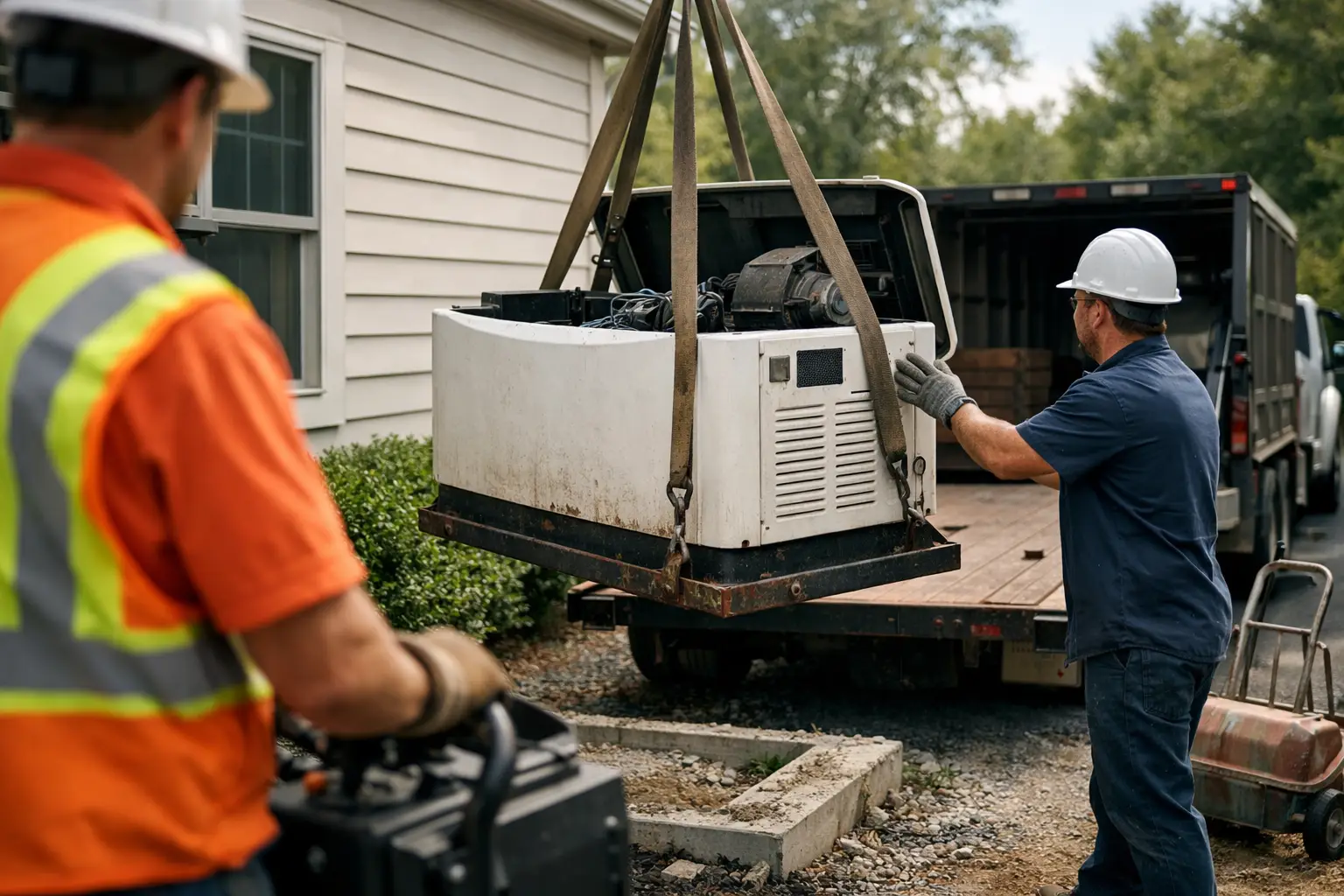
Generator Removal and Disposal Done Right
A retired generator rarely leaves quietly. It sits on a pad, tied into fuel, exhaust, switchgear, controls, and sometimes years of improvised site changes. By the time generator removal and disposal becomes urgent, the real challenge is usually not the machine itself. It is everything connected to it – access, safety, environmental exposure, downtime risk, and the question of whether the asset still has recoverable value.
For facility owners and operations teams, that matters. A standby generator can weigh several tons, contain regulated fluids, and sit in a live environment where adjacent systems cannot be disrupted. In a data center, telecom site, plant, or utility setting, removal is never just a hauling job. It is a decommissioning project with compliance, logistics, and cost implications.
What generator removal and disposal really involves
The phrase sounds simple, but the work is layered. Before any rigging begins, the generator has to be evaluated in place. That means confirming size, weight, access points, structural constraints, and the condition of connected systems. Fuel lines, electrical feeders, battery systems, exhaust runs, day tanks, sound attenuation enclosures, and concrete pads all affect scope.
The disposal side is just as important. Some generators are scrap. Others contain components with resale or refurbishment value, especially late-model units, serviceable engines, alternators, radiators, enclosures, and associated infrastructure. Treating every retired generator as waste usually leaves money on the table.
That is why experienced contractors start by separating three questions. Can the unit be removed safely? Can the project be executed without disrupting adjacent operations? And can any portion of the equipment be remarketed, recycled, or reclaimed to offset overall cost?
Why disposal decisions should not start with the dumpster
In industrial settings, disposal should be the last step in the decision tree, not the first. A generator package often includes recoverable ferrous and non-ferrous metals, reusable components, and support equipment that still carries market value. Depending on age, runtime, maintenance history, emissions tier, and manufacturer, the asset may qualify for direct purchase, salvage, part-out, or responsible recycling.
The trade-off is condition and location. A clean, well-documented generator in an accessible yard is very different from a corroded unit inside a partially decommissioned plant. Transportation costs, crane requirements, fuel remediation, and labor intensity can shift the economics quickly. In some cases, resale makes sense. In others, metal recovery and environmentally sound recycling are the more practical path.
For that reason, the best generator removal and disposal plans are built around asset evaluation, not assumptions. A serious recovery partner looks at both risk and residual value before setting the final disposition route.
Planning the removal before the first bolt is touched
Most project problems begin during scoping, not execution. If the site walk misses embedded conduit, overhead clearance limits, soft ground conditions, or shared utility pathways, the removal plan can fail fast. The same is true when teams underestimate disconnection work or assume old drawings match current field conditions.
A disciplined scope should account for electrical isolation, fuel system drain-down, battery removal, coolant and oil handling, fire protection interfaces, and any demolition needed to extract the unit. Indoor installations often require more sequencing than outdoor units because ventilation components, doors, louvers, and wall sections may need temporary modification.
Access is usually the deciding factor. A 2,000 kW generator with good crane access may be more straightforward than a much smaller unit buried inside an active facility. It depends on where the machine sits, how it was installed, and what systems must stay live around it.
Safety and compliance are not side issues
Generator retirement touches multiple risk areas at once. There is electrical isolation, lockout/tagout, fuel management, fluid recovery, rigging, lifting, transport, and waste handling. If the unit has been idle for years, condition uncertainty adds another layer. Corrosion, degraded mounts, stuck fasteners, and residual fuel contamination are common.
Compliance requirements also vary by site and jurisdiction. Used oil, coolant, diesel, batteries, and certain electronic components may require specific handling and documentation. Facilities with internal EHS procedures, utility rules, or customer-facing uptime requirements need a contractor that can work within those controls rather than around them.
This is where specialized industrial experience matters. Generator removal in a mission-critical facility is not the place for improvisation. The project team needs a clear chain of custody for materials, a site-specific safety plan, and the equipment to dismantle and extract heavy assets without creating secondary damage.
When value recovery changes the economics
Not every retired generator has resale potential, but many do have recoverable value. That value may come from the complete unit, from major assemblies, or from raw material streams. Engines, alternators, control panels, copper-bearing components, aluminum radiators, and steel enclosures all affect the project outcome.
For owners replacing backup power infrastructure, this can be the difference between a pure disposal cost and a more balanced asset recovery project. A provider that can purchase equipment, remarket viable assets, and recycle the remainder under one scope can simplify budgeting and reduce vendor fragmentation.
There is also a timing advantage. If the same partner handles evaluation, dismantling, removal, logistics, and final disposition, decisions happen faster. That matters when a facility is working against a construction schedule, lease surrender date, utility cutover, or plant shutdown window.
Common generator disposal scenarios
The right approach depends on why the generator is leaving service. In replacement projects, the priority is often schedule control. The old unit has to come out cleanly so the new system can be installed without delay. In facility closures, the focus may shift toward maximum recovery across multiple asset classes, not just the generator. In emergency removals after damage or failure, speed and containment usually take precedence over resale.
Emission compliance can also drive retirement. Older diesel units may still run, but no longer fit the site’s regulatory or operational requirements. In those cases, owners often want to know whether the generator has secondary market value outside its current application. Sometimes it does. Sometimes transportation and refurbishment costs outweigh that opportunity.
That is why there is no single disposal formula. The best path depends on equipment condition, market demand, project timeline, site access, and the cost of extraction.
Choosing a partner for generator removal and disposal
This is one of those projects where scope depth matters more than a low initial number. A contractor may quote simple removal, but exclude fluid handling, ancillary equipment, pad demolition, transport coordination, environmental documentation, or recycling. Those gaps tend to show up later as change orders, delays, or site liability.
A stronger approach is to work with a provider that understands the full asset chain. That includes de-energizing and disconnecting the system, dismantling associated infrastructure, rigging and transport, evaluating resale potential, and routing materials into compliant recycling streams when reuse is not practical.
For multi-site operators, geographic reach also matters. Coordinating generator removals across different states or provinces gets easier when one company can standardize reporting, safety expectations, and disposition methods. Critical Asset Recovery is built around that model – combining equipment recovery, decommissioning, and responsible recycling for complex infrastructure projects.
What a well-run project looks like
A good generator removal project is usually uneventful, and that is the point. The schedule is clear. Isolation and fluid recovery happen before heavy work starts. Rigging is matched to actual site conditions. Materials are documented. Recyclables are separated properly. The site is left clean and ready for the next phase.
Just as important, the owner knows where the value went and where the waste went. There is a record of what was purchased, what was recycled, and what was disposed of through the appropriate channels. That level of accountability protects both the budget and the organization.
If you are planning generator retirement, start with a realistic assessment of the asset, the site, and the end goal. The right disposal outcome is not always scrap, and the lowest-cost removal plan is not always the lowest-risk one. When the work is scoped correctly from the start, generator removal becomes less of a disruption and more of a controlled transition.