
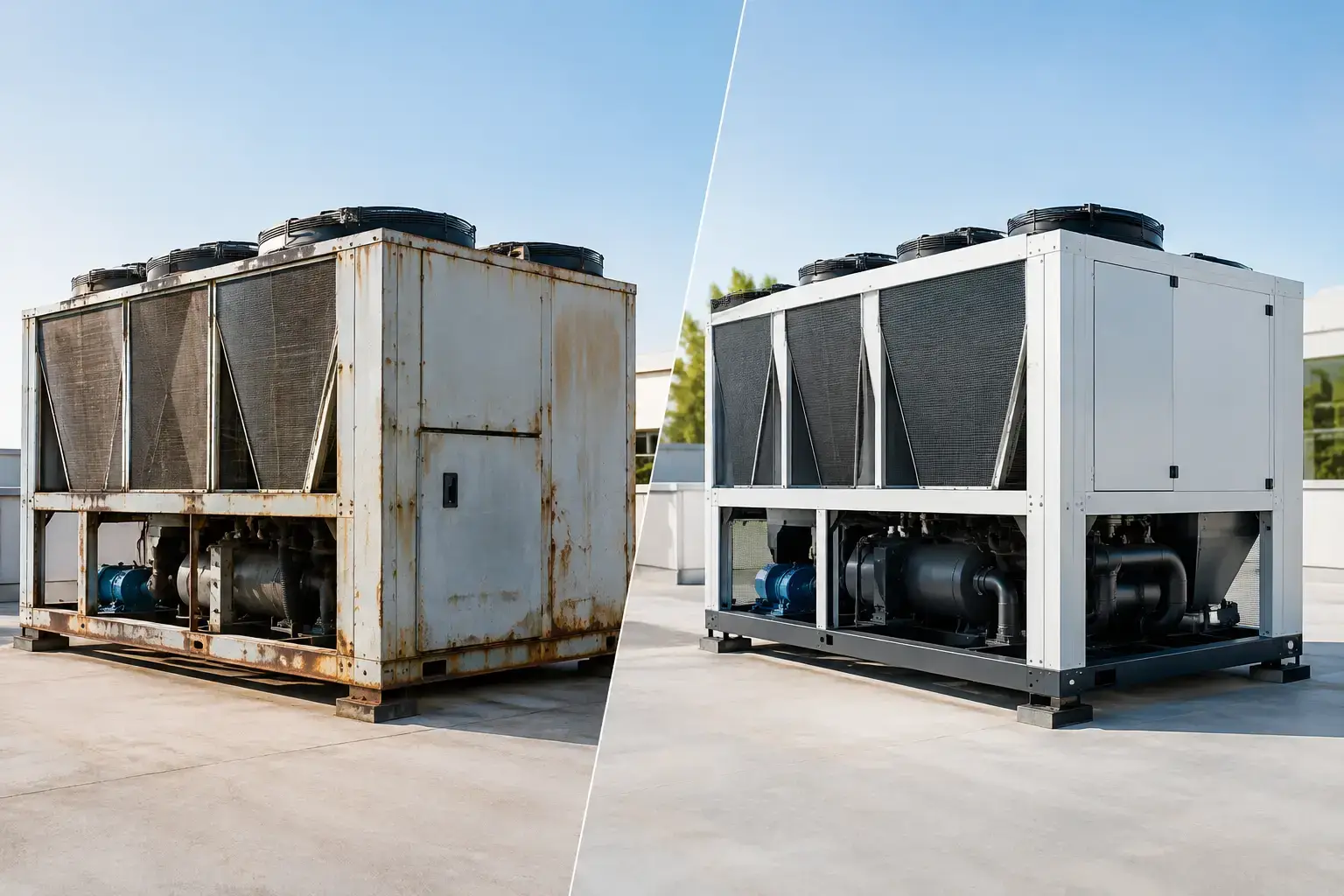
Refurbished Chillers Versus New – Which Fits?
A chiller replacement rarely happens at a convenient time. A plant expands, a data center cooling load changes, a legacy unit fails, or an aging system becomes too expensive to maintain. In each case, the decision between refurbished chillers versus new equipment affects capital budgets, project schedules, operating risk, and the facility’s ability to maintain reliable cooling.
The lower purchase price of a refurbished unit can be compelling, particularly when capacity is needed quickly. A new chiller may offer the latest efficiency features and a full manufacturer warranty, but it can also require a longer lead time and substantially more capital. The right choice depends on the equipment’s condition, the application, available support, and how much risk the facility can reasonably accept.
Start With the Operating Requirement
The first question is not whether a used chiller costs less. It is whether the unit can reliably meet the facility’s actual cooling requirement. That includes required tonnage, leaving-water temperature, condenser-water conditions, electrical characteristics, controls integration, footprint, rigging access, and redundancy expectations.
For a comfort-cooling application with seasonal demand, a properly refurbished chiller may be a practical fit. For a critical process line, hospital environment, high-density data center, or other operation where cooling loss creates immediate business exposure, the evaluation needs to be more conservative. Redundancy, response time for service, available parts, and contingency planning carry as much weight as the nameplate capacity.
A strong equipment assessment also accounts for future load. Buying a unit that only meets today’s minimum demand can create another replacement project sooner than expected. Conversely, excessive oversizing can reduce operating efficiency and increase cycling. The goal is a chiller matched to the system, not simply the largest unit available.
Refurbished Chillers Versus New: Cost and Schedule
Upfront cost is often the clearest difference. Refurbished chillers generally require less capital than comparable new equipment. For organizations managing a facility closure, temporary capacity need, expansion project, or budget-constrained replacement, that difference can preserve funds for piping, electrical work, controls upgrades, installation, or other critical scope.
Availability can be equally valuable. New chiller procurement may involve manufacturing queues, equipment configuration, shipping coordination, and site preparation over an extended period. When an existing unit fails or must be removed on a fixed shutdown schedule, an available refurbished unit can reduce the time between decision and installation.
That advantage has limits. A lower acquisition price does not automatically mean lower project cost. Freight, crane work, foundation modifications, piping changes, refrigerant handling, electrical upgrades, commissioning, and controls integration must be included in the comparison. Older equipment may also require more attention to documentation and parts planning.
New equipment is usually easier to specify around a planned project. It can be selected for exact capacity, current efficiency targets, preferred controls, voltage, and site constraints. If the project timeline supports it, this can reduce adaptation work and provide a more predictable path from design through startup.
What Proper Refurbishment Should Mean
The term “refurbished” is used loosely in the equipment market. A chiller that has been cleaned and repainted is not equivalent to a unit that has been inspected, tested, repaired, and prepared for a defined application. Facility teams should ask for a clear scope of work rather than relying on a condition label.
A credible refurbishment process begins with identification and inspection. The seller should be able to provide the manufacturer, model, serial number, tonnage, electrical data, refrigerant type, dimensions, and known operating history when available. The physical review should address heat exchangers, compressors, condenser and evaporator condition, controls, electrical components, structural condition, insulation, piping, and evidence of leaks or corrosion.
Depending on the equipment type and condition, refurbishment may include cleaning, tube inspection, pressure testing, oil analysis, replacement of wear components, controls repair, electrical testing, leak checks, and operational verification. The required work is not identical for every chiller. A packaged air-cooled unit, a water-cooled centrifugal chiller, and an absorption machine present different inspection priorities and different levels of risk.
Ask what was tested, what was replaced, what remains original, and what warranty or startup support is included. A documented answer is more useful than a general assurance that the unit is in good condition.
Efficiency Is More Than the Nameplate
New chillers typically provide an advantage in full-load and part-load efficiency, especially when replacing equipment from an older generation. Modern compressors, heat exchangers, variable-speed technologies, and controls can reduce energy use under the right operating profile. For facilities with high annual run hours or expensive utility rates, that reduction may justify a higher purchase price.
Still, the efficiency decision should be based on the actual duty cycle. A chiller that operates intermittently as backup capacity may not produce enough annual energy savings to offset the premium for a new unit. A refurbished system serving a temporary installation or a building scheduled for redevelopment may be the financially disciplined choice.
The refrigerant question also deserves attention. Evaluate the refrigerant in the proposed unit, its service availability, regulatory considerations, and the long-term plan for maintaining the machine. Equipment with difficult-to-source refrigerant or limited service support can become expensive to own even when its purchase price is attractive.
Risk, Serviceability, and Asset Life
New equipment offers a known starting point. The buyer receives current documentation, manufacturer support, defined warranty coverage, and an expected service life that begins at installation. That certainty matters when the chiller is central to production, environmental control, or uptime commitments.
A refurbished chiller carries more history. Its remaining useful life depends on original build quality, prior maintenance, operating hours, environmental exposure, and the quality of the refurbishment work. This does not make refurbished equipment unsuitable. It means the buyer should manage the purchase as an engineering and risk decision rather than a simple price comparison.
Serviceability can shift the decision either way. A well-known older platform with readily available parts and technicians familiar with the controls may be easier to maintain than a newer specialized system. On the other hand, obsolete controls, discontinued compressor components, or limited documentation can turn a low-cost purchase into an ongoing maintenance burden.
Before committing, confirm who will service the equipment, how quickly critical parts can be obtained, whether controls can communicate with the building management system, and what backup cooling exists during an outage. These questions are especially relevant when a refurbished unit will become the primary source of cooling.
Consider the Removal and Environmental Scope
Replacing a chiller is not just an equipment purchase. The retiring unit must be isolated, drained, disconnected, rigged out, transported, and handled in accordance with safety and environmental requirements. Refrigerant recovery, oil management, electrical disconnection, and recycling of metal and components all require disciplined execution.
A full-service asset recovery approach can improve both the economics and the schedule. Surplus chillers, pumps, switchgear, UPS systems, generators, and related infrastructure may retain resale or material value. Coordinating removal, asset disposition, recycling, and site cleanup under a defined scope reduces handoffs and helps facility teams maintain control over a complex project.
Critical Asset Recovery supports this type of work by managing equipment recovery and responsible disposition alongside dismantling and removal requirements. For facilities retiring multiple systems or preparing a site for renovation, coordinated execution can be as valuable as the equipment decision itself.
A Practical Decision Framework
A refurbished chiller is often the better choice when the required capacity is available, the unit has been properly evaluated, the application can tolerate the remaining-life risk, and schedule or capital constraints are significant. It can also be a sound fit for temporary cooling, backup capacity, leased facilities, planned shutdowns, and projects where existing infrastructure limits the value of a highly customized new unit.
New equipment is often the stronger choice when long-term energy performance is a priority, the cooling load is highly critical, the facility requires exact configuration, or manufacturer warranty and support are essential to the operating plan. It also makes sense when installation is part of a larger capital project designed around current codes, controls, and efficiency objectives.
The most effective purchasing decision comes from comparing total project cost and operational exposure, not just the quote. Define the cooling requirement, inspect the available equipment, verify the refurbishment scope, model installation costs, and establish a service plan before the old chiller is disconnected. That preparation gives the facility a practical path forward, whether the best answer is a restored asset or a new machine built for the next phase of operations.