
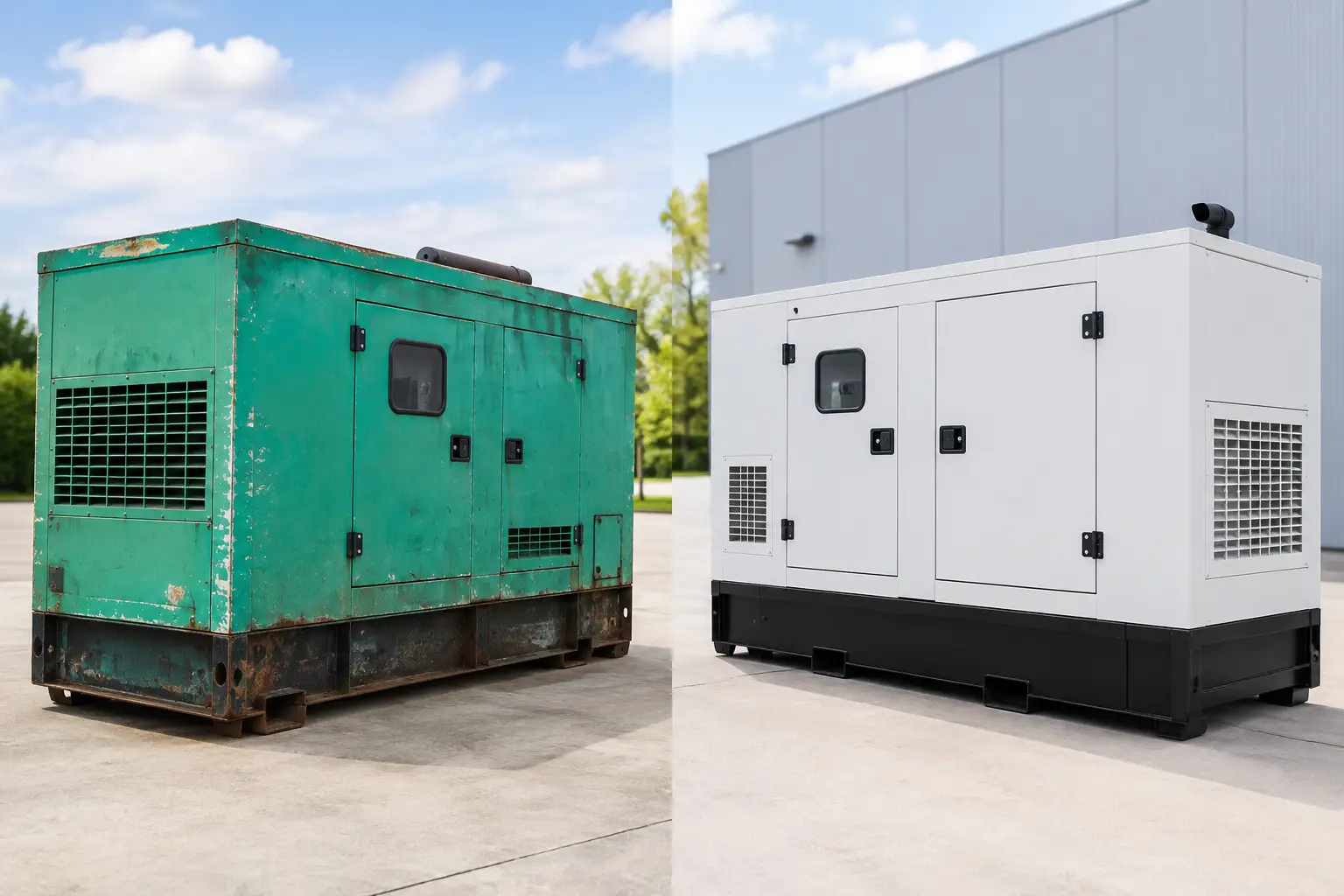
Refurbished Generators Versus New Generators
A standby generator that does not start during a utility failure is not a cost-saving measure. It is an operational exposure. When evaluating refurbished generators versus new generators, facility leaders need to look beyond the purchase price and assess the condition of the asset, its intended duty, available documentation, installation requirements, and the consequences of downtime.
For a data center, telecom site, manufacturing plant, substation, or other critical facility, the right choice depends on more than whether the equipment is used. A properly rebuilt generator with verified performance can be a sound investment. A new unit can be the better decision when emissions rules, warranty requirements, capacity needs, or project timelines demand it.
Refurbished Generators Versus New Generators: The Real Decision
The most visible difference is capital cost. Refurbished equipment generally costs less than a comparable new generator, particularly for larger diesel units and complete packages that include enclosures, controls, tanks, and associated switchgear. For facilities replacing an existing unit with similar specifications, that savings can preserve budget for installation, fuel-system work, electrical upgrades, or other resilience projects.
But price alone does not establish value. A lower-cost generator becomes expensive quickly if it requires unplanned repairs, cannot meet local air-quality requirements, lacks compatible controls, or introduces commissioning delays. Conversely, a new generator with a long lead time may be a poor fit for a site that must restore backup capacity quickly.
The practical question is not whether refurbished or new equipment is inherently better. It is whether the generator can deliver dependable power for the facility’s load profile, regulatory environment, and expected service life.
When a Refurbished Generator Makes Business Sense
Refurbished generators are often a strong fit when the facility needs dependable standby capacity without the cost or procurement lead time of new equipment. This is particularly true for replacement projects where the incoming equipment can match the existing voltage, frequency, footprint, fuel type, and distribution arrangement.
A quality refurbishment is more than cleaning and repainting. The scope should address the engine, alternator, cooling system, fuel system, starting batteries, controls, wiring, and enclosure condition as applicable. It should also include inspection records and functional testing. For critical-duty applications, a documented load-bank test is one of the clearest indicators that the generator has been evaluated under meaningful operating conditions.
Refurbished equipment can also be advantageous where an older generator model is already integrated into the site. Maintaining a familiar platform may reduce engineering changes, simplify parts stocking, and avoid a broader redesign of the automatic transfer switch, paralleling controls, exhaust routing, or fuel infrastructure.
There is an environmental benefit as well. Extending the useful life of viable industrial equipment reduces unnecessary disposal and preserves the material and energy already invested in the asset. That benefit is meaningful only when the equipment is suitable for continued service and is processed responsibly. Equipment that cannot be returned to safe, reliable operation should be recycled through proper channels rather than pushed back into service.
What to Verify Before Buying Refurbished Equipment
Condition must be documented, not assumed. Engine hours provide context, but they are not a complete measure of generator health. A lightly used unit that sat outdoors with neglected maintenance may present more risk than a higher-hour unit that received consistent service in a controlled environment.
Review the serial numbers, manufacturing date, operating hours, maintenance history, and reason for removal when available. Confirm the generator’s rated kW and kVA, voltage configuration, phase, frequency, power factor rating, and standby or prime-power designation. A unit sized for standby emergency use may not be appropriate for continuous or prime operation.
Also assess whether the controls will integrate with the facility. Older control systems can create challenges with remote monitoring, alarm reporting, automatic transfer switches, paralleling gear, and building management systems. In some cases, controls can be upgraded cost-effectively. In others, the modification cost removes much of the initial savings.
Physical condition matters just as much. Inspect the base frame, enclosure, radiator, exhaust components, fuel tank, hoses, electrical terminations, vibration mounts, and signs of corrosion or fluid leaks. Transport and rigging plans should be reviewed early, especially when the replacement unit must pass through limited-access areas or be set on an existing pad.
Where New Generators Have the Advantage
New generators offer the clearest path when a project requires current emissions compliance, a manufacturer warranty, customized engineering, or a specific configuration that is not readily available in the secondary market. They are often the preferred option for greenfield construction, major expansions, and high-profile facilities with strict owner specifications.
A new package can be designed around the exact site conditions: altitude, ambient temperature, required runtime, acoustic limits, seismic requirements, fuel type, enclosure rating, and electrical distribution. That level of customization is valuable when the generator is part of a larger system with redundant utility feeds, UPS equipment, multiple transfer switches, or parallel operation.
New equipment also reduces uncertainty around remaining service life. The buyer receives a current production unit with known installation requirements, updated controls, and a defined warranty structure. For organizations with standardized equipment programs across many sites, those factors can justify a higher initial investment.
Still, new does not always mean immediately available. Large generator packages, specialized enclosures, switchgear, and emissions-related components can carry substantial manufacturing and delivery lead times. Site readiness, permitting, fuel-system installation, and electrical commissioning can extend the project further. If a facility has lost backup capacity, a well-qualified refurbished unit may restore resilience faster while a long-term replacement strategy is completed.
Compliance, Permitting, and Risk Cannot Be Afterthoughts
Generator decisions are closely tied to local and state requirements. Emissions standards, permitting thresholds, fuel-storage rules, noise ordinances, fire-code requirements, and electrical-code compliance can vary by jurisdiction. A generator that worked at its prior location may not automatically qualify for installation at another site.
This is especially relevant when relocating older diesel equipment. The engine’s manufacturing date, emissions tier, operating classification, annual run-hour limits, and intended use can affect whether it is permissible at the new facility. Emergency standby use and non-emergency operation are often treated differently. Verify requirements with the appropriate local authorities and engineering team before committing to an asset.
The same discipline applies to supporting equipment. A generator package may require upgrades to the transfer switch, circuit protection, fuel supply, containment, ventilation, exhaust system, or monitoring controls. The purchase decision should account for total installed cost, not just the generator’s sale price.
Compare Total Cost of Ownership, Not Just Acquisition Cost
A useful comparison starts with the expected operating horizon. If the unit will serve as temporary capacity for a leased site, a bridge during construction, or a short-term redundancy measure, a refurbished generator may offer the best financial outcome. If it will support a core facility for 20 years, the benefits of a new package and full warranty may carry greater weight.
Build the comparison around acquisition, freight, rigging, installation, permitting, engineering, controls integration, maintenance, fuel consumption, testing, expected repairs, and eventual disposition. Include the cost of being without the generator if delivery, installation, or repairs slip. For a mission-critical operation, risk often carries more weight than the equipment’s invoice price.
A refurbished generator should be evaluated against the cost to bring it to the required standard. If it needs significant engine work, a new control system, enclosure repairs, updated batteries, fuel-tank remediation, and electrical modifications, the gap between refurbished and new equipment may narrow. If those items have already been addressed and supported by test documentation, the value equation changes materially.
Plan the Replacement and Retirement Together
Generator replacement is also an asset-disposition project. Removing a retired unit can involve fuel recovery, battery handling, electrical isolation, crane work, demolition of supporting infrastructure, transportation, and recycling of metals and components. Poor coordination can delay installation and create unnecessary safety or environmental exposure.
Critical Asset Recovery helps organizations manage this transition by combining equipment recovery, decommissioning, removal, resale, refurbishment, and responsible recycling. A coordinated scope can help recover residual value from surplus generators and related infrastructure while keeping the work aligned with site safety and shutdown requirements.
The strongest generator decision is the one supported by complete information: verified equipment condition, realistic installed costs, documented testing, a clear compliance path, and a removal plan for the equipment leaving the site. Before approving either option, define the load the generator must protect and the failure risk the facility can actually afford to carry.