
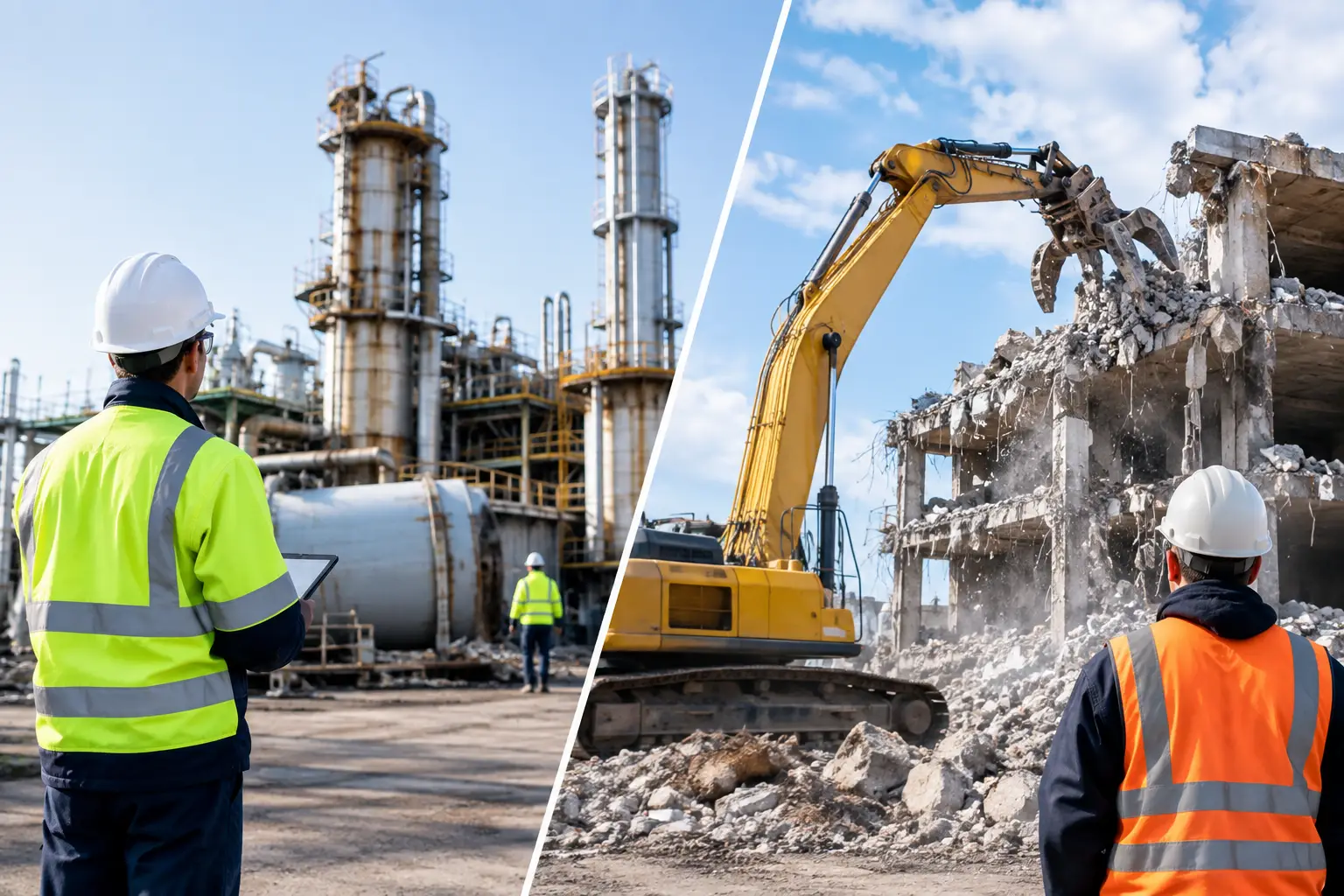
Decommissioning Contractor vs Demolition Contractor
A decommissioning contractor vs demolition contractor decision affects far more than how quickly a space is cleared. For a data center, telecom site, substation, plant, or equipment room, the choice determines whether usable assets are recovered, sensitive systems are handled correctly, environmental obligations are met, and the site is left ready for its next purpose.
The two services can overlap. Both may manage labor, lifting, hauling, safety controls, and removal of equipment or structures. The difference is in the primary objective. Decommissioning is a controlled asset-retirement process. Demolition is the removal or destruction of a structure or physical component. Complex facilities often need both, but usually in the right sequence.
What a Decommissioning Contractor Does
A decommissioning contractor plans and executes the retirement of equipment, infrastructure, and supporting systems. The work begins with understanding what is installed, what remains operational, what has residual value, and what requires special handling before it can leave the site.
In a mission-critical environment, that may include generators, UPS systems, battery strings, switchgear, PDUs, cooling equipment, raised flooring, fire suppression agents, cabling, and processing equipment. The contractor coordinates safe isolation, disconnection, dismantling, rigging, packaging, transportation, resale, recycling, and documentation. If a facility remains partially active, the work must also protect live operations and preserve access, power paths, and environmental controls for equipment that stays in service.
The central question is not simply, “How do we remove this?” It is, “What is this asset worth, what risks does it carry, and what is the correct disposition path?” A late-model generator, chiller, or electrical distribution component may have meaningful resale value. Copper, steel, batteries, electronics, refrigerants, and other materials also require different recovery or recycling channels.
A capable decommissioning scope commonly includes a detailed inventory and disposition plan. It identifies equipment for resale, reuse, recycling, or disposal before crews begin removal. That planning can reduce waste, prevent accidental scrapping of valuable assets, and give facility owners a clearer view of project economics.
What a Demolition Contractor Does
A demolition contractor is typically engaged to remove buildings, structural elements, slabs, walls, foundations, tanks, interior build-outs, or other physical construction. The goal is generally to clear the site, prepare it for renovation, or return the property to a condition suitable for redevelopment.
Demolition may involve selective interior demolition or full structural teardown. Depending on the project, it can require excavation, concrete breaking, structural engineering, dust control, waste hauling, and site grading. The work is highly specialized and essential when the building envelope or major structural components must go.
Equipment removal can be part of demolition, but it is not necessarily an asset recovery program. A demolition scope may focus on speed and material volume rather than serial-number tracking, resale evaluation, specialized electrical isolation, or preservation of equipment condition. That approach can be appropriate for obsolete, damaged, or low-value materials. It can be expensive when applied to recoverable infrastructure.
Decommissioning Contractor vs Demolition Contractor: The Practical Difference
The most useful distinction is this: decommissioning preserves control over assets and systems; demolition removes the physical environment around them or removes the environment itself.
A decommissioning contractor typically works in phases. First comes site assessment and inventory. Next, the team develops a method of procedure, safety plan, equipment disposition strategy, and removal schedule. Systems are isolated and dismantled in a sequence that protects personnel, operations, and recoverable equipment. Assets are then sold, repurposed, recycled, or disposed of through the appropriate channels.
A demolition contractor typically starts from a different set of requirements: what must be removed, what structural conditions exist, what permits are required, and how the property will be prepared for the next construction phase. The work may be selective and careful, but its end state is usually an empty or altered structure rather than a managed asset disposition outcome.
Neither service is automatically better. The proper choice depends on what is being retired and what must remain. If a facility owner is removing nonrecoverable partitions and concrete while preserving no infrastructure, demolition may be the direct answer. If the project includes high-value power, cooling, telecom, or manufacturing equipment, decommissioning should usually occur before structural demolition begins.
When Decommissioning Should Lead the Project
Decommissioning should lead when a project involves critical infrastructure, resale potential, regulated materials, or an operating facility nearby. This is common during data center consolidations, telecom upgrades, plant shutdowns, substation modernization, and replacement of aging backup power or cooling equipment.
Consider a data center retiring a room of UPS systems, battery cabinets, switchgear, CRAC units, and raised flooring. Sending a general demolition crew into that room without an asset plan may create avoidable losses. Batteries require proper handling. Electrical equipment must be verified as de-energized. Refrigerant-containing equipment requires compliant recovery. Raised floor panels, copper bus, and serviceable hardware may have reuse or recycling value. A decommissioning team addresses those factors before the room is stripped.
The same principle applies to generators and fuel-related systems. A generator may be a marketable asset, but only if it is removed with appropriate rigging, protected during transport, and documented accurately. Supporting components, including tanks, cabling, exhaust systems, and controls, may need separate disposition paths. Treating the full package as general debris can eliminate value that could help offset project costs.
When Demolition Is the Right Primary Scope
Demolition becomes the primary scope when the structure itself is the asset being retired. A shuttered plant may need walls, mezzanines, foundations, process pits, or entire buildings removed. A renovation may require selective demolition of interiors after the valuable equipment is already removed. A damaged structure may require urgent stabilization and controlled demolition before any other work can proceed.
Even then, an asset recovery review has value. Before a demolition phase starts, identify equipment and materials that should be removed separately. This early review is particularly useful for switchgear, transformers, generators, chillers, batteries, fire suppression systems, and specialized process equipment. It can prevent a demolition schedule from forcing a one-size-fits-all disposal decision.
Why Sequencing Protects Cost, Safety, and Schedule
The most reliable projects use a sequence built around operational reality. In many cases, the order is assessment, isolation, decommissioning, asset removal, environmental handling, selective demolition, and final structural demolition. The exact sequence changes if the facility is still operating, if there are tenant requirements, or if a buyer needs equipment extracted on a specific timeline.
Poor sequencing creates friction quickly. Demolition can restrict access needed for rigging. Unplanned disconnections can affect adjacent systems. Equipment can be damaged before it is evaluated. Materials can become mixed, making recycling less efficient and documentation harder to produce. What looks like a faster approach at the start can create change orders, delays, and lost recovery value later.
A single provider with asset recovery and removal expertise can simplify coordination, especially when equipment purchasing, dismantling, transportation, recycling, and site-clearing services need to work together. Critical Asset Recovery approaches these projects with the understanding that industrial equipment is not automatically waste. The right disposition plan can turn a facility retirement into a more controlled, cost-conscious operation.
Questions to Ask Before Selecting a Contractor
Before awarding the work, clarify the scope in operational terms. Ask whether the contractor will inventory assets before removal, identify equipment with resale value, and provide a documented disposition plan. Confirm who is responsible for lockout/tagout coordination, electrical verification, battery handling, refrigerant recovery, rigging, waste manifests, and final site condition.
Also ask how the contractor manages active operations. A contractor working beside live data center or plant infrastructure needs more than general labor capacity. They need defined work windows, access controls, communication protocols, contingency planning, and personnel who understand the consequences of a wrong cut or unplanned outage.
Pricing deserves the same scrutiny. A low removal price may exclude transportation, recycling fees, specialty handling, cleanup, or documentation. Conversely, an asset recovery proposal may include equipment purchase value that changes the overall project cost. Compare complete scopes and net outcomes, not only the first number on a quote.
The strongest decision begins with an honest assessment of what remains valuable, what must be removed safely, and what the site needs to become next. When those answers are clear before crews mobilize, decommissioning and demolition can work together without sacrificing control, compliance, or recoverable value.