
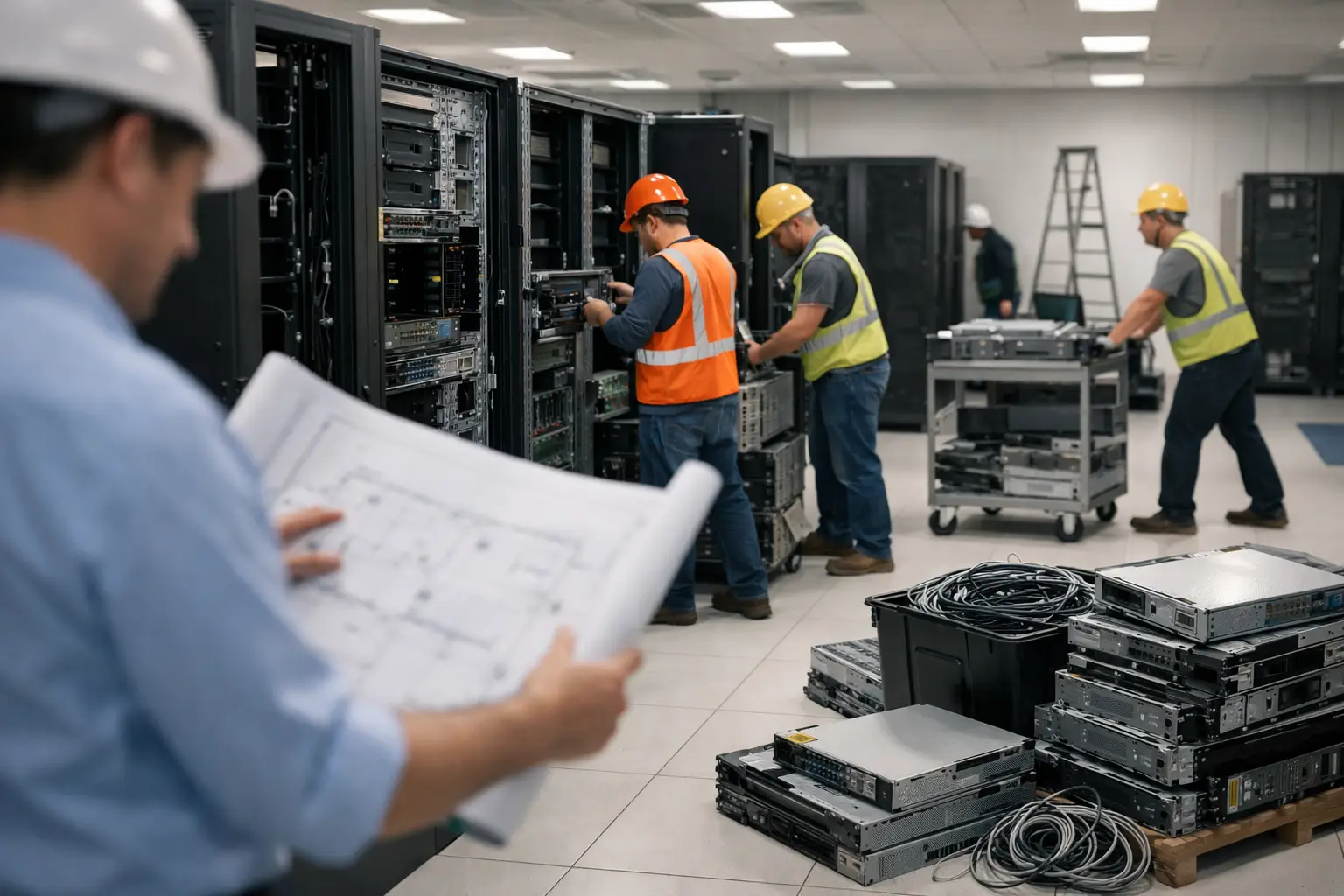
Data Hall Teardown Requires a Controlled Plan
A data hall teardown is not a standard demolition project. Behind every cabinet row are live dependencies, concentrated electrical capacity, battery strings, cooling connections, fire protection systems, and equipment with both resale potential and regulated disposal requirements. The work must protect personnel, preserve the building, control downtime, and establish a clear chain of custody for every asset leaving the site.
For facility owners and operations leaders, the best outcome is rarely achieved by treating retired infrastructure as scrap. A controlled teardown can recover value from usable equipment, reduce removal costs, support environmental objectives, and leave the space ready for its next purpose. That requires disciplined planning before the first disconnect is made.
What a Data Hall Teardown Actually Includes
The scope can range from removing a few rows of raised flooring and cabinets to retiring an entire data center floor, including its supporting mechanical and electrical infrastructure. The exact work depends on whether the site is being closed, consolidated, renovated, or converted for another use.
A complete project may involve server cabinets, PDUs, busway, UPS systems, battery cabinets, switchgear, transfer switches, generators, CRAC or CRAH units, chillers, containment systems, fire suppression equipment, copper cabling, raised floor panels, and underfloor support structures. Some of these assets can be remarketed. Others require recycling, specialized handling, or destruction documentation.
The distinction matters. A contractor focused only on removal may see a room full of disposal material. An experienced asset recovery provider evaluates what can be sold, refurbished, recycled, or responsibly disposed of before the project scope is finalized. That process helps clients make better decisions about cost, schedule, and recovery value.
Start With an Accurate Asset and Site Assessment
A successful data hall teardown begins with a physical walk-through, not a generic equipment list. Asset records are useful, but they often do not reflect field modifications, equipment relocations, missing components, or units that remain connected to building systems.
The assessment should identify equipment by manufacturer, model, capacity, age, condition, and accessibility. It should also document the path from the data hall to the loading area. Door widths, freight elevator limits, floor loading, dock access, crane requirements, security procedures, and work-hour restrictions can all affect the removal plan.
Electrical and mechanical conditions deserve equal attention. Teams need to confirm which systems are de-energized, which circuits remain active, how stored energy will be controlled, and whether cooling loops, fuel lines, or fire suppression connections must be isolated. This is where a teardown can become complicated quickly. A UPS may be offline, for example, while its battery system or upstream distribution remains energized.
A detailed inventory also establishes the basis for asset disposition. Equipment that is complete, well-maintained, and still supported in the secondary market may have recoverable value. Equipment with obsolete components, damage, or limited demand may be a better candidate for material recycling. The answer depends on condition, market demand, transportation costs, and the client’s schedule.
Sequence the Work Around Operational Risk
The order of removal is central to safety and continuity. Infrastructure should never be dismantled simply because it is closest to the exit. The project team must work from an approved sequence that reflects the facility’s shutdown plan and any systems that need to remain available until a final cutover.
In many projects, IT equipment and cabinets are removed before supporting distribution, containment, and flooring. Electrical distribution follows after lockout/tagout procedures, verification of de-energization, and confirmation that no downstream load remains. Battery systems require their own controlled process because of weight, stored energy, chemical hazards, and transportation rules.
Cooling equipment may be removed later in the sequence, particularly when temporary conditioning is needed for adjacent operations. Where refrigerants are present, recovery and handling must be completed by qualified personnel. Fire suppression equipment also requires careful coordination so that protection is not unintentionally compromised in occupied portions of the facility.
A written sequence reduces uncertainty between the owner, general contractor, electrical contractor, facilities team, and recovery provider. It also creates clear stop points. If field conditions do not match the approved plan, the crew can pause, reassess, and proceed safely rather than improvising around a critical system.
Protect Value Before Equipment Is Moved
Heavy equipment loses value quickly when it is handled without a recovery plan. A functional UPS cabinet can become less marketable if it is tipped, exposed to weather, separated from its accessories, or loaded without proper protection. The same is true for switchgear sections, generator components, cooling units, and raised floor systems.
Recovery begins with proper identification and documentation. Serial numbers, condition notes, photographs, and accessory lists help establish what is available for resale or refurbishment. Equipment should be disconnected, palletized, crated, or secured according to its size and transport requirements. Sensitive electronics, removable modules, and controls may require different packaging than steel enclosures or mechanical equipment.
There is also a practical financial question: is preservation worth the effort? For high-value, late-model equipment, careful handling can materially improve recovery. For aging or damaged assets, the added labor may exceed potential resale returns. A dependable provider explains that trade-off early rather than promising value that cannot be realized after removal.
Manage Recycling and Disposal With Documentation
Not every retired asset has a second-life market, but nearly every asset contains materials that should be managed responsibly. Copper, aluminum, steel, lead, electronics, batteries, refrigerants, and fire suppression agents require different recovery paths. Sending mixed equipment to a landfill is rarely the most responsible or cost-effective option.
Battery removal is particularly sensitive. Whether a site contains valve-regulated lead-acid batteries, flooded cells, lithium-ion systems, or another chemistry, the handling plan should address safe disconnect procedures, packaging, staging, transport, and downstream recycling. Damaged batteries or units with signs of swelling, leakage, or heat exposure may need additional controls.
Clients should also expect documentation that supports internal environmental reporting, compliance needs, and project closeout. Depending on the scope, records may include equipment inventories, weight tickets, certificates of recycling or destruction, bills of lading, and final disposition reports. These documents are not administrative extras. They establish accountability after equipment has left the facility.
Plan for the Physical Demolition Work
Once assets are removed, the hall may still contain substantial infrastructure. Raised floors can conceal cable trays, abandoned cabling, grounding systems, piping, and underfloor debris. Overhead areas may include containment, busway, ladder rack, ductwork, and monitoring equipment. Each component must be evaluated for safe removal and material separation.
Flooring removal deserves special attention. Panels, pedestals, stringers, ramps, and perimeter supports may be reusable or recyclable, but their condition varies across the room. Removing them too early can also affect crew access and material handling. In some projects, portions of the raised floor remain in place until large cabinets and distribution equipment have been removed.
The final condition of the space should be defined before work begins. Does the owner need a swept, broom-clean room? Should wall penetrations be sealed, slab openings repaired, or disconnected utilities capped? Is the next tenant planning a new data hall, office conversion, warehouse use, or complete building renovation? Clear acceptance criteria prevent scope gaps at the end of the project.
Choose a Partner That Can Own the Full Scope
Fragmenting a teardown among separate buyers, haulers, electricians, recyclers, and demolition crews can create coordination gaps. It may work for a small, straightforward project, but larger facilities benefit from one accountable team that can manage recovery, dismantling, rigging, logistics, recycling, and reporting under a coordinated plan.
Critical Asset Recovery approaches data hall retirement as an asset disposition project first and a removal project second. That means evaluating reusable equipment, planning safe extraction, coordinating downstream recycling, and aligning the work with the client’s operational and environmental requirements. Nationwide coverage also helps organizations maintain a consistent process across multiple locations.
The right provider will ask precise questions about energization status, equipment condition, access, security, schedule, and desired final site condition. They should provide a defined scope, identify exclusions, and explain how changes in field conditions will be handled. That level of clarity protects both the project budget and the shutdown schedule.
When a shutdown date is fixed, the best time to plan asset recovery is before equipment is disconnected. Early assessment gives the project team more options, more control over risk, and a better chance to turn retired infrastructure into measurable value rather than an avoidable disposal cost.