
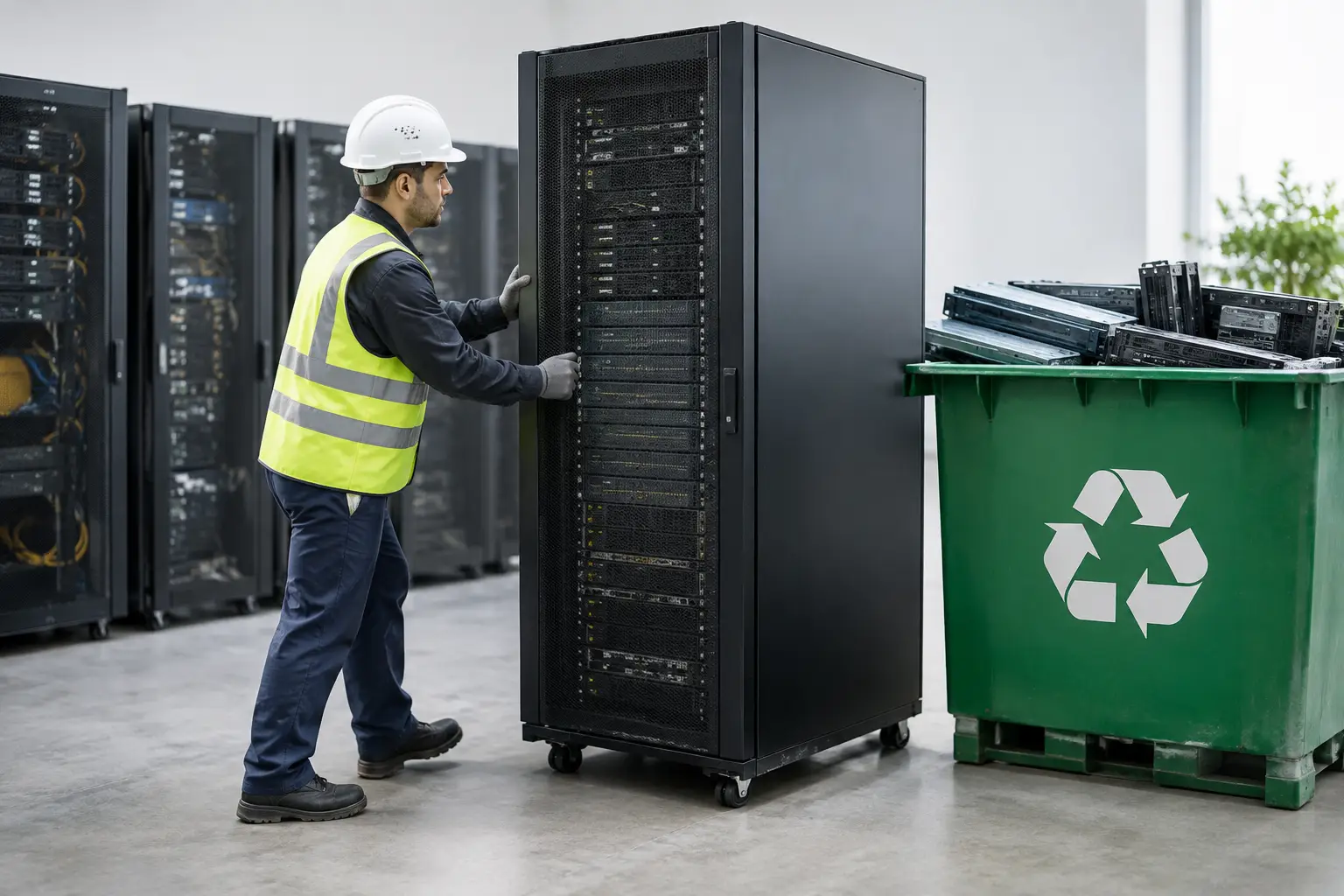
How to Recycle Server Racks Without Added Risk
A retired server rack is rarely just a steel cabinet headed for a scrap bin. It may still be anchored to a raised floor, connected to ladder trays, carrying legacy power distribution, or surrounded by equipment that remains in service. Knowing how to recycle server racks begins with treating rack removal as part of a controlled infrastructure decommissioning project, not a simple hauling task.
For data centers, telecom sites, industrial facilities, and network rooms, the best outcome is usually a combination of reuse, resale, material recovery, and documented recycling. The right path depends on rack condition, installed components, site access, project timing, and the value of the equipment being retired alongside the enclosure.
Start With an Asset and Site Assessment
Before any rack is disconnected or unbolted, establish what is being removed and what must remain operational. A physical inventory should identify rack manufacturer, dimensions, enclosed or open-frame configuration, condition, installed accessories, and whether cabinets are empty. Include related items such as PDUs, cable managers, ladder racks, blanking panels, containment doors, shelves, KVM hardware, and overhead support components.
This assessment separates reusable assets from material that has reached end of life. Standard 19-inch cabinets in good condition may have resale or redeployment value, especially when they include doors, side panels, rails, and intact grounding hardware. Older proprietary enclosures, damaged cabinets, heavily modified frames, or racks with missing components may be better candidates for recycling.
The site review matters just as much as the inventory. Confirm loading dock access, freight elevator capacity, aisle widths, floor loading limits, security requirements, and the route from the white space to the truck. A 42U cabinet may appear straightforward to move until it must pass through a narrow doorway, cross a raised floor, or be handled near live electrical infrastructure.
Decide Whether to Reuse, Resell, or Recycle
Recycling is responsible, but it should not automatically be the first disposition option. Reuse generally preserves more value and avoids the energy required to process raw materials. If racks are current, structurally sound, and compatible with common equipment footprints, they may be suitable for internal redeployment or secondary-market resale.
Resale value depends on more than appearance. Buyers typically evaluate brand, height, depth, load rating, door type, rail availability, seismic features, cosmetic condition, and local freight economics. A high-quality cabinet can still have limited resale potential if shipping costs exceed its market value. Conversely, a large quantity of matching racks can be attractive when it is palletized, documented, and ready for pickup.
When resale is not practical, recycling recovers the materials that remain valuable. Server racks are commonly made from steel, aluminum, copper-bearing grounding components, plastics, glass, and mixed hardware. Accessories may contain additional recoverable material, but they should be separated where possible rather than treated as one mixed load.
Plan the Removal Sequence Before Work Begins
The safest way to recycle server racks is to remove them in a defined sequence that protects people, active systems, and the facility itself. Start with a written scope that identifies the racks, associated equipment, exclusions, shutdown windows, access rules, and final destination for each asset category.
A disciplined sequence usually includes these actions:
- Confirm all servers, storage, network devices, and media have been removed under the facility’s data security procedures.
- De-energize and verify isolation of rack-mounted power equipment before disconnecting cords, whips, or distribution components.
- Remove cable bundles, ladder tray drops, fiber pathways, and overhead containment in a controlled order.
- Detach accessories and loose components before moving the cabinet or frame.
- Release floor anchors only after the rack is empty, stable, and ready for handling.
- Protect floors, walls, door frames, and adjacent operating equipment during transport.
The details vary by site. In a live data center, rack removal may need to occur during an approved maintenance window and in stages that preserve cooling containment and aisle access. In a full facility shutdown, the priority may shift toward production speed, labor coordination, and outbound freight staging. Neither approach should sacrifice safety controls or chain-of-custody documentation.
Address Safety and Facility Risks
Empty racks are bulky, and many are top-heavy once doors, panels, or overhead connections are removed unevenly. Cabinets should be evaluated for stability before anchors are released. Use trained personnel, appropriate moving equipment, and clear travel paths. Do not assume casters are rated for every condition, particularly when a cabinet must cross floor transitions or uneven surfaces.
Raised-floor environments deserve additional attention. Removing a cabinet can expose cutouts, unsupported tiles, grounding connections, or underfloor cabling. If racks are bolted through floor tiles or supported by pedestals, the removal team must understand the floor system before disassembly begins. Leaving open penetrations or compromised tiles behind creates a safety and operations issue for the next phase of the project.
Overhead work introduces another set of risks. Cable tray, busway, containment, and fire suppression interfaces may run directly above retired cabinets. These systems should be surveyed before any lifting, cutting, or dismantling occurs. Where penetrations are changed, restore firestopping and maintain the facility’s required separation and containment conditions.
Separate Rack Materials From Electronic Equipment
A common mistake is to send an entire rack load to a general recycler without separating cabinets from IT equipment, batteries, power devices, and cable. That approach can reduce recovery value and create unnecessary compliance exposure.
Server racks themselves are primarily a ferrous and nonferrous metal recovery stream. The equipment inside them requires a different process. Servers, switches, storage arrays, and telecom devices may contain data-bearing media and need documented sanitization or destruction. UPS units, battery strings, and power distribution equipment may require specialized handling because of weight, chemistry, stored energy, or regulated components.
Cables also warrant sorting when project scale justifies it. Copper-bearing cable, fiber assemblies, and mixed low-voltage material have different recovery characteristics. Separating high-value materials at the point of removal can improve value recovery while keeping the project area cleaner and easier to manage.
Maintain Documentation From Removal to Final Disposition
A responsible rack recycling program should produce records that match the project’s operational and environmental requirements. At a minimum, maintain an asset list, removal authorization, pickup or shipping records, and a clear accounting of whether racks were reused, sold, recycled, or disposed of as residual material.
For larger decommissioning projects, photographs, serial-number records for associated equipment, weights, material manifests, and certificates of recycling may be appropriate. Documentation is particularly useful when a facility owner must demonstrate that retired infrastructure was managed according to internal sustainability policies, lease obligations, customer requirements, or corporate reporting standards.
Chain of custody matters most for electronics and storage media, but it also strengthens the overall project. A documented handoff from facility to recovery provider reduces uncertainty about where material went and who was responsible at each stage. It also gives operations leaders a cleaner closeout package when the project is complete.
Choose a Provider That Can Handle the Entire Scope
The lowest hauling quote is not always the lowest project cost. A provider that only removes empty cabinets may leave the facility to coordinate electrical disconnection, equipment removal, cable recovery, demolition, freight, recycling, and site restoration through separate vendors. That creates more scheduling points, more handoffs, and more room for scope gaps.
For complex sites, look for a recovery partner that can assess value, purchase reusable equipment, dismantle supporting infrastructure, manage heavy removal, coordinate transportation, and recycle nonresalable material responsibly. Nationwide coverage can be especially useful for organizations standardizing retirements across multiple data centers, telecom facilities, plants, or regional sites.
Critical Asset Recovery approaches infrastructure retirement as an asset disposition and execution project. That means evaluating what can be recovered, planning how it can be removed safely, and managing the material streams that follow – from reusable cabinets and facility equipment to recyclable metals and specialized components.
Leave the Space Ready for Its Next Use
The work is not finished when the last rack reaches the loading dock. Inspect the room for remaining anchors, cable debris, floor openings, damaged tiles, unprotected penetrations, and abandoned grounding connections. Confirm that removed containment or pathway components have not affected adjacent active rows or building systems.
A well-executed recycling project leaves behind a safer, cleaner space and a documented disposition path for the material removed. That is the practical standard to hold for every server rack retirement: recover value where it exists, recycle responsibly where it does not, and complete the work without creating the next facility problem.