
Fire Suppression Agent Disposal for Retired Sites
A fire system can be out of service in a matter of hours, but fire suppression agent disposal requires a controlled plan long before cylinders are disconnected or equipment is removed. For data centers, telecom facilities, plants, and other critical sites, the agent is only one part of the project. Cylinders, piping, detection equipment, alarms, room integrity requirements, transportation controls, and environmental obligations all need to be managed in the right sequence.
Treating a suppression system as ordinary scrap creates avoidable risk. An uncontrolled release may expose personnel, interrupt adjacent operations, damage recoverable equipment, or create regulatory and documentation issues. A disciplined disposition process protects the site while making room for equipment removal, renovation, or shutdown work to proceed on schedule.
Why Fire Suppression Agent Disposal Needs a Project Plan
Retired suppression systems are common in facilities undergoing modernization or decommissioning. A data hall may be transitioning to a new protection design. A telecom switch site may be consolidating. A manufacturing area may be closing, changing its hazard classification, or replacing legacy controls. In each case, the system should remain operational until the facility’s fire protection plan allows it to be taken offline.
The disposal method depends on the agent, system condition, cylinder ownership, local requirements, and whether the material can be recovered for reuse or must enter an approved waste-handling stream. There is no responsible one-size-fits-all answer.
Clean-agent systems may contain HFC, HFK, fluoroketone, or inert gas agents. Older facilities may still have halon systems, which require especially careful handling because of the environmental significance of the agent. Carbon dioxide systems present a different safety profile, particularly in occupied or enclosed areas. Foam concentrates, dry chemical systems, and water-based systems also require their own evaluation. The label on a cylinder is a starting point, not a complete disposition plan.
A qualified project team should establish four things before work begins: what agent is present, how much is present, whether the system remains active, and what downstream path is authorized for recovery, recycling, reclamation, or disposal. Those answers drive the schedule, labor plan, safety controls, and cost.
Start With an Accurate Site Inventory
The most productive disposal projects begin with a physical inventory, not an assumption based on old drawings. Facility records can be incomplete after years of tenant changes, upgrades, emergency repairs, and phased construction.
Document each protected area, cylinder bank, control panel, discharge nozzle network, and related detection device. Record agent type, cylinder quantity, cylinder size, pressure status, visible condition, manufacturer information, and accessible serial numbers. Note whether cylinders are connected, isolated, discharged, damaged, or stored separately from the active system.
This survey should also identify access constraints. Cylinder banks may be in roof-level mechanical rooms, raised-floor spaces, remote equipment yards, or secure telecom areas. The path from the room to the loading area affects lifting equipment, staffing, site security, and transport timing. A seemingly simple cylinder removal can become difficult when it must pass through an occupied white space, a restricted corridor, or an operating production floor.
Photographs and an asset schedule create a reliable basis for bids, chain-of-custody records, and final reporting. They also help separate items with potential resale or reuse value from materials that require specialized recycling or disposal.
Verify Protection Before Isolation
No suppression system should be disabled merely because a facility is scheduled for retirement. Confirm the status of the building, occupancy, electrical loads, insurance requirements, authority having jurisdiction, and any temporary fire-watch requirements before isolation.
In phased decommissioning work, some rooms may be vacant while adjacent areas remain operational. The fire protection strategy must reflect that reality. Isolating a shared releasing panel or removing detection components without verifying system boundaries can affect protection outside the intended work area.
Coordinate with the facility’s fire protection contractor and internal safety team to establish isolation procedures, impairment notifications, lockout and tagout requirements, and restoration steps where applicable. This protects personnel and prevents a disposal project from becoming an unplanned operational event.
Recovery Is Preferable to Release
For many agent types, controlled recovery is the responsible alternative to venting. The goal is to transfer the agent using appropriate equipment and trained personnel, preserve it where practical, and direct it to a legitimate downstream channel. The correct path may be reuse, reclamation, recycling, or compliant destruction, depending on the material and its condition.
Environmental impact is a major consideration. Some legacy and fluorinated agents have high global warming potential or ozone-depletion concerns. Releasing them to the atmosphere can be environmentally harmful and may violate applicable requirements. Even where a release appears expedient, it can create unnecessary liability and undermine a facility owner’s environmental commitments.
Inert gas agents may not carry the same environmental concerns, but recovery and removal still require planning. Pressurized cylinders present handling hazards, and releasing gas in confined spaces can create an oxygen-deficient atmosphere. Carbon dioxide demands particular attention because it can create a serious life-safety hazard in enclosed or low-lying areas.
The recovery method should match the system and the site. It depends on agent chemistry, cylinder condition, available access, transfer equipment, and the receiving facility’s acceptance criteria. Do not assume that a cylinder can be transported or processed simply because it is no longer connected to a fire system.
Manage Cylinders, Hardware, and Electronics Separately
A suppression system is a mix of materials with different value and disposal paths. Once agents have been safely recovered, cylinders may be evaluated for reuse, refurbishment, recycling, or scrap processing. The answer depends on certification status, physical condition, valve type, and market demand.
Piping, manifolds, brackets, nozzles, and structural supports often contain recoverable metal. Releasing panels, detectors, notification devices, batteries, and wiring should be handled as electronic or regulated material when appropriate. Separating these streams improves accountability and can reduce unnecessary disposal costs.
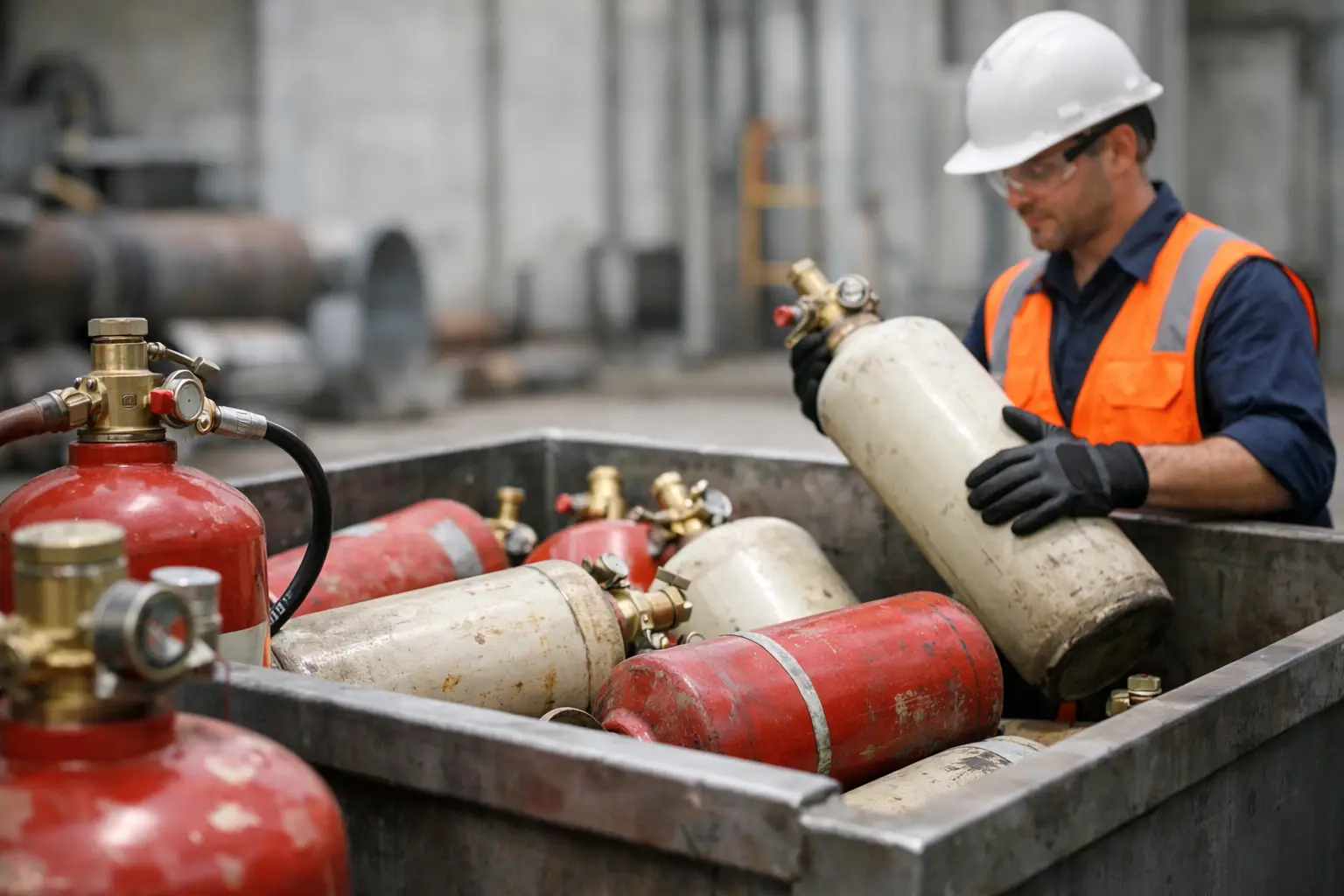
Do not send intact cylinders into a general scrap stream. Cylinders require confirmation that they are empty, depressurized where required, and prepared according to the receiving recycler’s procedures. Valves and residual contents must be managed correctly. A recycler needs clear information about what it is receiving, especially when cylinders are damaged, unlabeled, or part of an older installation.
This is where a full-service asset recovery provider can simplify execution. Instead of coordinating separate vendors for agent recovery, rigging, dismantling, transportation, metal recycling, and cleanup, facility owners can establish one defined scope with clear handoffs and documentation.
Build Documentation Into the Scope
The final paperwork is not an administrative afterthought. It is evidence that the project was conducted with appropriate control. Required records vary by location, agent type, and project scope, but a strong closeout package commonly includes the asset inventory, recovery quantities, cylinder disposition, transport records, recycling or disposal certificates, and photographs of completed removal areas.
For large decommissioning projects, align this documentation with the broader asset disposition report. Operations leaders may need it for environmental reporting, lease turnover, insurer communication, audit support, or internal capital-project records. Clear records also help resolve questions that arise after the site has been transferred, renovated, or demolished.
Chain of custody matters most when material changes hands. Know who recovered the agent, who transported it, where it was received, and how the cylinders and associated equipment were processed. Vague assurances are not a substitute for traceable documentation.
Coordinate Disposal With the Larger Decommissioning Schedule
Suppression-system removal is often tied to other critical-path work. Raised-floor removal, UPS retirement, generator extraction, switchgear demolition, cable removal, and building turnover can all affect access to protected rooms. If the agent recovery crew arrives after access routes have been blocked or lifting equipment has been demobilized, costs and delays follow.
Early coordination is especially valuable in live or partially active facilities. Work windows may be limited, escorts may be required, and shutdown approvals may take weeks. A detailed sequencing plan identifies when the system can be impaired, when cylinders can be recovered, when piping can be removed, and when the room can be released for the next trade.
Critical Asset Recovery approaches this work as part of an integrated facility disposition plan. The objective is not simply to remove equipment. It is to recover value where possible, control environmental exposure, and leave the site ready for its next use.
Before approving any removal scope, walk the system in the field, verify the agent and protection boundaries, and define the final disposition path for every cylinder. That preparation is what turns a difficult fire protection retirement into a controlled, documented project outcome.